



Blog
Why Humans Love Stories: The Psychology of Storytelling

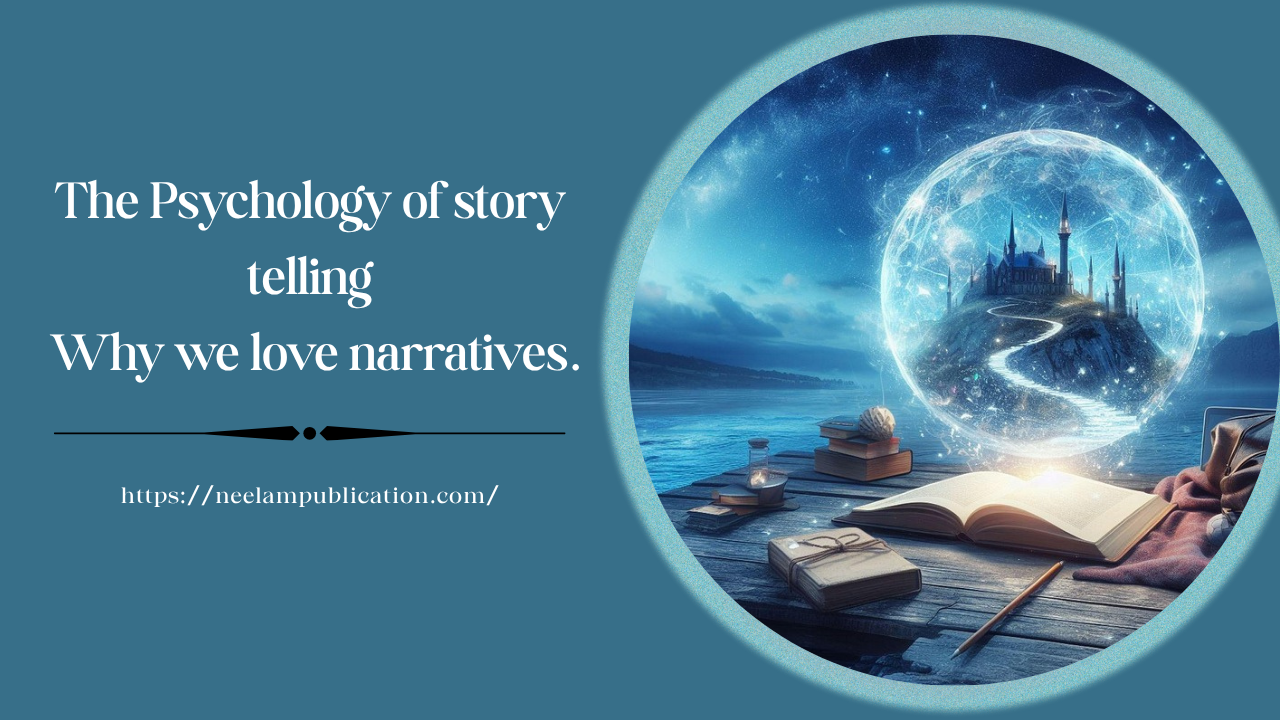
Why Humans Love Stories: The Psychology of Storytelling :-
A human loves narratives. From the old days to the Modern world, humans have been communicating stories and narratives through cave paintings, novels, and films. Humans have loved storytelling. Many Psychologists and neurologists agree that storytelling is more entertaining and is important for our emotions. The story is also recorded in our memory and also stirs our emotions and imagines the planned scenes while helping us to learn without any real risk. Narratives capture our attention far more than raw facts. Narratives help us to understand other cultures and empathize with their
thought process and socialization. Humans also remember situations in our mind like a story, rather than only facts, so we can remember them
1. Stories Are How Humans Think
Psychology Behind Storytelling Explained NEELAM PUBLICATION
Why humans are drawn towards Stories is how the human thinking process is that the human brain does not list down their thoughts like facts. We like stories. When a problem arises, we look for the cause and the effect of the problem and then solve it. We understand a situation better if told in a narrative style that than isolated facts like
E.g., students understand and remember history better when taught in a narrative style.
2. Stories Trigger Emotions

Psychology Behind Storytelling Explained NEELAM PUBLICATION
While hearing a story we don’t only listen to the story, but we feel the emotions within the story. Stories can stir one’s emotions. They make us cry, laugh, feel angry, feel sad and many more emotions which cannot be expressed. And a connection is built. Neuroscience also shows us that emotional events are remembered more vividly than neutral ones.
The amygdala (emotion center of the brain) works with the hippocampus (memory center) to encode emotional experiences more deeply. This explains why we forget numbers, statistics, but not forget one’s story, which emotionally moved us.
E.g., humans re-watch the same shows again and again to feel the emotions, which deepens the connections with the show.
3. Mirror Neurons and Empathy

Why Humans Love Stories: The Psychology of Storytelling NEELAM PUBLICATION
Mirror neurons are a type of neuron that mirrors our emotions of ourselves and others. This builds a bridge between them and converts into a shared experience. Mirror neurons make storytelling a powerful tool that creates a human connection
Humans feel empathy for other people because we not only understand the story we feel, but also frame ourselves in the story.
E.g., while watching a movie, if the character is sad, we not only see the scene but we feel the sadness and the emotions, which is why people cry during sad scenes in a movie.
4. Stories Simplify Complexity

Why Humans Love Stories: The Psychology of Storytelling NEELAM PUBLICATION
Life is messy and overwhelming. Humans do not understand information in facts, lists and scattered data. It overwhelms us. But storytelling complex information in a structural form is easy to understand and to remember because humans like to follow narratives, which make connections and are easy to understand. If difficult information is explained with the help of characters, stories, and in a sequence like cause, conflict and outcome, it becomes a lot easier to understand.
E.g., students understand and remember history better when taught in a narrative style.
5. Identity and Meaning-Making

Why Humans Love Stories: The Psychology of Storytelling NEELAM PUBLICATION
Humans are natural storytellers. We try to understand ourselves through stories. We often define ourselves through stories. We also store our personal life journey like stories, in the form of lessons, Success and other forms. Narratives also play a big part in building our identity, like national or cultural stories give us a sense of belonging in big groups. Narratives aren’t just entertainment; they’re central to how we build identity and understand the world.
E.g., in India, freedom struggle stories are told in a form of courage and unity, giving us individuals a sense of belonging as citizens in this country.
6. Social Bonding

Why Humans Love Stories: The Psychology of Storytelling NEELAM PUBLICATION
Since ancient times, storytelling has been a bonding tool. Storytelling around the fire helps us to build connections with others. Stories also teach us lessons. Through sharing stories, one’s culture is preserved, and communities are built stronger. In today’s day, people still bond through movies, novels, or even memes, which make new communities and Bonding.
E.g., people follow each other on social media if they find out the other person likes the same football team or music group as them.
7. Dopamine and Reward System

Why Humans Love Stories: The Psychology of Storytelling NEELAM PUBLICATION
Dopamine is a type of neurotransmitter that strengthens memory pathways and emotionally intense movements. What engages us during the climax scenes in a movie, what not only makes them interesting but also makes them unforgettable. That’s why we might forget an important college lecture but will never forget the powerful ending of a film.
E.g., we binge-watch movies or reread novels whose endings are unforgettable.
Psychology Behind Storytelling Explained
This teaches us that storytelling is not only a form of entertainment, but it’s more than that. Stories help to arrange random events into a form of sequence, like cause-conflict-outcome, which makes it easier to understand and is unforgettable. Stories also help us to feel emotions through various neurons in our brain, which help us to build strong connections and communities between individuals. Stories help us build our identity. From ancient storytelling around the fire to modern novels, films, and digital media, stories remain humanity’s way of creating meaning.
This was Psychology of Storytelling presented by Neelam Publication, which is a respected publishing house that helps authors to publish books, whether they are novels, poems, fantasy, etc. If you want to publish your books, please contact our publication at this contact number 9892153444. For further information visit :- https://neelampublication.com/